
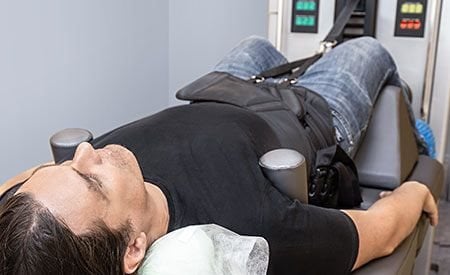
Mechanical Spinal Decompression is a therapeutic technique often used by chiropractors to create space between vertebrae, stretch muscles, and take pressure off nerves and/or the spinal cord. Other terms for spinal decompression are Vertebral Axial Decompression, Spinal Traction or Axial Traction. This technique is non-invasive and generally painless.
Anatomy Affected by Spinal Decompression
The spinal column, or vertebral column, is a remarkably stable structure made up of vertebrae (bones) that protect the spinal cord. Between each of the vertebrae is a disc that is made of cartilage. There are nerves that begin at the spinal cord and travel through a small hole (called a foramen) in the side of each vertebra to the rest of the body. The nerves are responsible for detecting changes in temperature and position as well as signaling muscles and producing pain when the nerves are irritated, injured or damaged. Gravity and physical activity can put pressure on our spinal column throughout each day. That pressure “squeezes” out a little bit of fluid from the discs, and the body rehydrates the disc at night when we are at rest. Imagine a kitchen sponge: When it’s wet, the sponge is softer and can absorb some shock. The more we squeeze it, the more water comes out—but when we add water to a dry sponge, it quickly absorbs the water and puffs up. This is similar to the way our discs work.
Spinal decompression affects the discs and nerves in the spine the most. In a healthy spine, the edges of the vertebrae and discs are stacked on top of one another to form a smooth curve, and the nerves between the vertebrae have plenty of space. However, over time or sometimes because of an injury, degeneration or inflammation, the discs can become flatter. This puts pressure on the nerves and can cause pain, weak muscles, and/or changes in our sense of touch. In these cases, the discs need a little more room to rehydrate and allow for optimal space for the nerves that exit the spinal cord. Spinal decompression works to create some extra space between each of the vertebrae using gentle traction, which in turn helps promote the movement of water, oxygen, and nutrient-rich fluids into the discs.
What Does Spinal Decompression Feel Like?
Spinal decompression feels like gentle, yet strong, stretching of the neck or low back, depending on the area being treated. For example, if the problem is in your lower back, a harness will be placed around your abdomen and just above your hips, and you may have a bolster or a small stool under your legs. The harness should be tight and secure, but not so tight that you can’t breathe comfortably. When the pulling begins, you may feel your entire body shift slightly for a few seconds, and then you will feel a gentle pull on the lower back. We will closely monitor you to make sure there is no discomfort during therapy. A device known as a flexion-distraction table may also be used, which is a flexible table that gently flexes the body in repeated motions to open spaces between the vertebrae.